
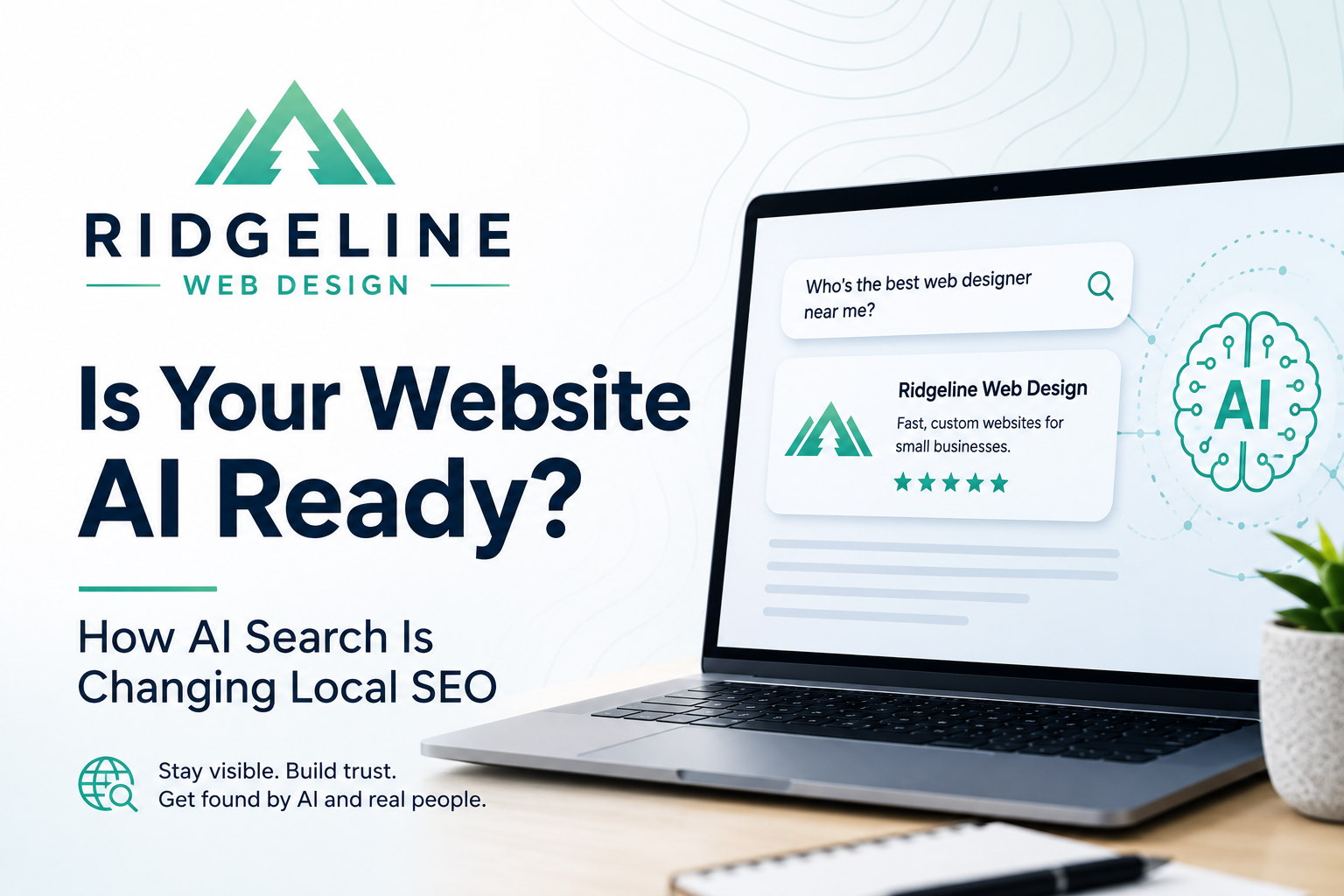
Is Your Website AI Ready? How AI Search Is Changing Local SEO

If you've searched for anything on Google lately, you've probably noticed things feel a little different.
Instead of seeing a page full of websites, Google is starting to answer questions right there on the results page. At the same time, more people are opening ChatGPT, Gemini, or other AI tools and asking questions the same way they'd ask a friend. They aren't searching "web designer Hubert NC" anymore. They're asking things like, "Who builds good websites for small businesses?" or "Can you recommend a reliable painter near me?". They're asking real questions and AI is trying to find those exact answers.
That might sound like a small change, but it's actually a pretty big shift in how people discover local businesses.
For years, the goal was simple. Build a website, do some SEO, collect a few reviews, and try to show up on the first page of Google. Those things still matter today, but they're no longer the whole picture. AI is becoming another place where people look for recommendations, and if your business isn't giving it enough information to understand who you are and what you do, you could be missing out on customers without even realizing it.
What Does It Mean to Have an AI Ready Website?
Whenever people hear the phrase "AI ready," they usually think they need to add an AI chatbot, automation, or some fancy new feature to their website. That's really not what this is about.
An AI ready website is simply a website that's easy to understand. It clearly explains what your business does, who you work with, where you provide your services, and why someone should trust you. Those same things help real people, but they also help AI understand whether your business is worth recommending when someone asks for help. With AI, it's analyzing the ins and outs of the website trying to see if it's the best fit for a search result. It wants to know everything you do.
In other words, if you've built a website that's genuinely useful for visitors, you're already moving in the right direction.
Helpful Businesses Are Going to Have an Advantage
Think about the questions people ask before they hire someone. If you're a roofer, they want to know how long a roof lasts. If you're a landscaper, they might ask when they should seed their lawn. If you're a plumber, they're probably wondering why their water pressure suddenly dropped.
For me, people ask things like why their website is slow, whether they really need a new one, or if a custom website is worth it over something like Wix or Squarespace. Every one of those questions is an opportunity.
Years ago, most business websites were basically digital brochures. They had a homepage, an About page, a contact page, and maybe a list of services. Today, that's usually not enough. The businesses that stand out are the ones that take the time to answer the questions their customers are already asking. Those articles don't just help the person reading them. They also help AI understand what your business knows.
AI Looks for Trust, Not Just Keywords
SEO has always involved keywords, but AI looks at a much bigger picture. Imagine someone asks, "Who's a good web designer for a small business?" AI isn't just looking for a website that says "web designer" twenty times. It's looking for evidence that the business actually knows what it's talking about. Does the website explain common problems? Does it answer real questions? Does it have helpful resources? Are there positive reviews? Is the business active online?
Those pieces work together to build trust. That's good news for small businesses because trust isn't something you can fake. It comes from consistently showing your experience and helping people solve problems.
Your Google Business Profile Still Matters
One misconception I've seen lately is that AI is replacing local SEO. I don't think that's true at all. Your Google Business Profile is still one of the first places people look before deciding to call you. Your reviews still matter. Your business information still needs to be accurate, and your website still needs to load quickly and explain what you do.
The difference is that AI is using many of those same signals when deciding which businesses to recommend. Instead of replacing local SEO, it's building on top of it. That's why I tell business owners not to chase every new trend. Focus on the fundamentals first because those fundamentals are becoming even more valuable.
A Fast Website Is Still One of Your Best Investments
Let's say AI recommends your business to someone looking for a contractor. They click your website and it takes eight or nine seconds to load. Half the images don't appear right away, the text jumps around while the page is loading, and the menu barely works on their phone.
There's a good chance you've already lost them. People expect websites to work. They don't think about page speed until something feels slow, and then it's all they notice. That's one of the reasons I spend so much time building lightweight, custom coded websites. A fast website isn't just good for Google. It creates a better first impression, and first impressions happen fast online.
So, Is Your Website Ready?
You don't need to rebuild your website every time technology changes. But it is worth asking whether your current site is actually helping your business. Does it answer the questions your customers ask every day? Does it clearly explain what makes your business different? Is it easy to use on a phone? Does it load quickly? Have you added anything new in the last year, or is it basically the same website you've had for the past five years?
Those questions matter because AI is rewarding the same things people have always appreciated: clear information, useful content, and businesses that know what they're talking about.
Looking Ahead
I don't think AI is replacing websites and I definitely don't think SEO is going away. If anything, I think the businesses that invest in helpful content are going to have an even bigger advantage over the next few years.
People still want to hire someone they trust. AI is simply becoming another way they find that person. If your website teaches, answers questions, and makes it easy for people to understand what you do, you're already building something that works well for both your customers and the future of search. And honestly, that's a much better long term strategy than trying to chase every new algorithm update that comes along.